
Lakewood Wood Flooring has handled wood floor refinishing in Lakewood, CA for more than 20 years, serving surrounding cities including Artesia, Bellflower, Hawaiian Gardens, Cerritos and Signal Hill. We sand, stain and refinish solid and engineered hardwood, and we recoat floors whose wood is still sound but whose finish has worn dull.
Refinishing is often the right first answer in this city because so many houses still carry the oak they were built with. More than half of Lakewood’s homes date from the 1950s, and the original Lakewood Park homes were sold with hardwood floors, so a tired floor under a rug or old carpet is frequently worth saving rather than replacing.
Before we quote, we check how much wood remains above the tongue, look for loose or damaged boards, and test the existing finish. That tells us whether your floor needs a light screen and recoat or a full return to bare wood, and it keeps the estimate honest about what the floor can take.
Recoat or Full Sand: Choosing the Right Refinish
Screen and Recoat for a Dull Finish
A screen and recoat abrades the top of the existing finish with a buffer and adds a fresh coat of polyurethane. It restores sheen and adds protection without removing any wood, and it is quicker and less disruptive than sanding. It only works when the wood underneath is undamaged and the old finish is clean enough for the new coat to bond.
We test that bond first. Floors cleaned for years with oil soaps, waxes or some spray products can carry a residue that makes a recoat peel, and a slippery floor finish is often the first sign. When we find contamination, we tell you before recommending a recoat that would not last.
Full Sand and Refinish to Bare Wood
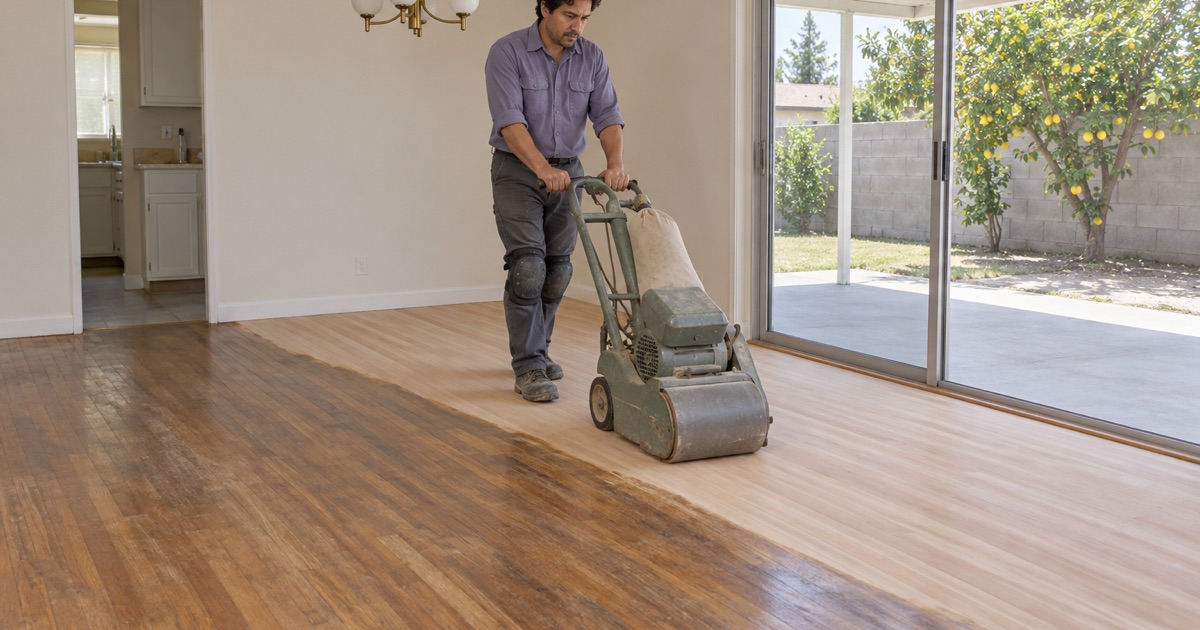
A full refinish takes the floor down to raw wood with a drum sander along the boards, an edger at the walls and an orbital sander to blend the two. It removes gray wood, deep scratches, water marks and most surface stains, and it is the only way to change the stain color.
We work through a grit sequence rather than jumping straight to a fine paper, because skipping grits leaves swirl marks that show clearly under a fresh finish. Between each pass we vacuum and inspect, so any chatter marks or low spots are corrected before stain goes on.
How Much Wood Your Floor Has Left
Solid hardwood can be sanded many times, but each sanding removes wood, and a floor that has been refinished repeatedly over 70 years may be close to the tongue. Engineered hardwood is limited by its wear layer thickness. We measure at a floor vent or threshold before sanding, so we never cut through what remains.
When a floor is too thin for another full sanding, that is not automatically the end of it. A careful screen and recoat can extend its life for years, and individual boards worn through can be replaced and woven in. We tell you which of those options your floor still has before recommending replacement.
Stain, Finish and Sheen for Refinished Hardwood
Stain Colors on Real Floor Samples
Stain looks different on red oak, white oak and maple, and it looks different again under your own windows. We sand test patches in the actual room and apply the colors you are considering, so you choose from real samples rather than a printed chart.
Maple and some other tight-grained species tend to take stain unevenly and can look blotchy. On those floors we either recommend a natural finish or use a conditioner and a lighter stain, and we show you the result on a test patch before committing the whole floor.
Waterborne and Oil-Modified Polyurethane
Waterborne polyurethane dries clear, cures faster and keeps a floor close to the color of raw wood. Oil-modified polyurethane adds warmth and ambers over the years, which some owners like on older oak. We explain the look and the cure time of each on your species before you decide.
Hardwax oil finishes are a third option. They soak into the wood rather than forming a film, look more matte, and can be spot-repaired, but they need more regular maintenance. We lay out that tradeoff plainly so you choose a finish that suits how your household uses the floor.
Low-VOC Finishes Legal in the South Coast Air Basin
Lakewood sits inside the South Coast air basin, where SCAQMD Rule 1113 limits wood coatings to 275 g/L of VOC. Every finish we apply is chosen from products that meet that limit, which also means less lingering odor in an occupied home.
Choosing a Sheen Level
Sheen runs from matte through satin and semi-gloss to gloss. Lower sheen levels hide scratches and dust better, which suits busy households and pets, while higher sheens reflect more light and show every mark. We apply a sample so you can see the sheen on your floor before the final coat.
Refinishing Older Lakewood Floors Safely
Lead-Safe Sanding in Pre-1978 Homes
Almost every house in Lakewood was built before 1978, so sanding near original painted baseboards, door casings and shoe molding can release lead dust. We follow EPA Renovation, Repair and Painting rule work practices, seal off the work area and use a dustless sanding system connected to extraction.
At the end of the job we clean the work area thoroughly before the finish coats go down. That protects your household during the work and keeps fine dust out of the finish itself.
Repairs Before the Sander Starts
Refinishing magnifies whatever is wrong with the boards. Before sanding, we refasten loose boards, deal with squeaks and nail pops, and cut out boards damaged by pet urine or water, weaving new wood into the existing floor so the repair disappears under the new finish.
Where a soft or bouncy spot points to a subfloor or joist problem, we trace it before refinishing rather than finishing over it. Structural work beyond a flooring repair is referred out, and we tell you that before you commit to anything.
Refinishing Before a Sale or Between Tenants
Refinished hardwood photographs well and often costs less than new carpet, which is why many owners refinish before listing a house or before a new lease. We schedule the work so the finish has time to cure before staging, photography or move-in, and we document the floor’s condition in writing for landlords who need a record of what was done between tenants.
For a rental turnover, a screen and recoat is often enough to refresh worn traffic lanes without taking the floor offline for long. Where pet damage or deep scratches have reached the wood, we quote the full sand or the board repairs separately so you can decide what the next lease justifies.
Our Step-by-Step Wood Floor Refinishing Process
Step 1: Inspect, Test and Measure
We check the species, remaining thickness, existing finish and any damaged or loose boards, and we test for finish contamination. You receive a line-by-line written estimate listing the sanding, repairs, stain, finish and any stairs separately.
Step 2: Prepare and Contain
Furniture comes out, shoe molding comes off where needed, and the rooms are sealed. On pre-1978 homes, we set up lead-safe containment before any sanding starts.
Step 3: Sand, Repair and Stain
We sand through the grit sequence, make board repairs, vacuum thoroughly and apply your chosen stain. Test patches are checked against the approved sample before the full floor is stained.
Step 4: Finish Coats and Cure Schedule
We apply the finish coats with abrasion between coats for bonding, reinstall trim, and hand you a written cure schedule. Work runs inside the city’s permitted construction hours, so the neighbors hear the sander only when they should.
- 20+ Years in Wood Flooring
- Line-by-Line Written Estimates
- Lead-Safe Sanding on Pre-1978 Homes