
Lakewood Wood Flooring handles hardwood floor repair in Lakewood, CA, bringing more than 20 years of wood floor work to every job, and serving surrounding cities including Artesia, Bellflower, Hawaiian Gardens, Cerritos and Signal Hill. We repair squeaks, gaps, cupping, loose and broken boards, pet stains, water marks and termite damage, and we weave new wood into old floors so the repair does not stand out.
Most hardwood problems can be fixed without replacing the whole floor. The key is working out why the problem appeared, because a cupped board replaced without finding the moisture behind it will cup again, and a squeak fastened without checking the subfloor may simply move a few feet. We diagnose first, then repair.
That matters in a city where so many floors are original. More than half of Lakewood’s homes were built in the 1950s, and their oak strip floors have had seven decades of wear, patching and recoats. Repairing those floors carefully preserves wood that is often better than what is sold new today, and our estimate lists each repair as its own line.
Diagnosing What Is Wrong With the Floor
Cupping, Crowning and Buckling
Cupping, where board edges sit higher than the centers, means the bottom of the board is wetter than the top. Crowning, the reverse, often follows when a cupped floor is sanded flat before it has dried. Buckling, where boards lift off the subfloor, points to a larger water event or a missing expansion gap.
We measure the moisture content across the affected area and in the subfloor with a wood moisture meter, and on a raised foundation we look into the crawl space for leaks or poor ventilation. Once the source is fixed and the wood dries, many cupped floors flatten enough to be sanded and refinished rather than replaced.
Gaps Between Boards
Some gapping is normal: wood shrinks in dry months and swells in humid ones, so seasonal gaps open and close. Those gaps are best left alone, because filler packed into a seasonal gap cracks and pops out when the boards swell again.
Gaps that keep growing, appear in one area only or show up alongside squeaks usually point to a moisture change, loose fasteners or a subfloor problem. We fix the cause first, then fill, replace or tighten boards depending on how wide the gaps are and how the floor is fastened.
Squeaks, Pops and Nail Pops
Squeaks and pops come from boards rubbing against each other, against loose nails, or against a subfloor that has shrunk away from its fasteners. Nail pops, where a fastener head works up through the surface, often appear alongside them.
We find the exact spot, then refasten from above with concealed fasteners or from below through the crawl space on a raised foundation. Where a squeak sits over a soft or bouncy area, we trace it to the subfloor and joists before quieting the surface.
Repairing Damaged Boards
Board Replacement and Weave-In Repair
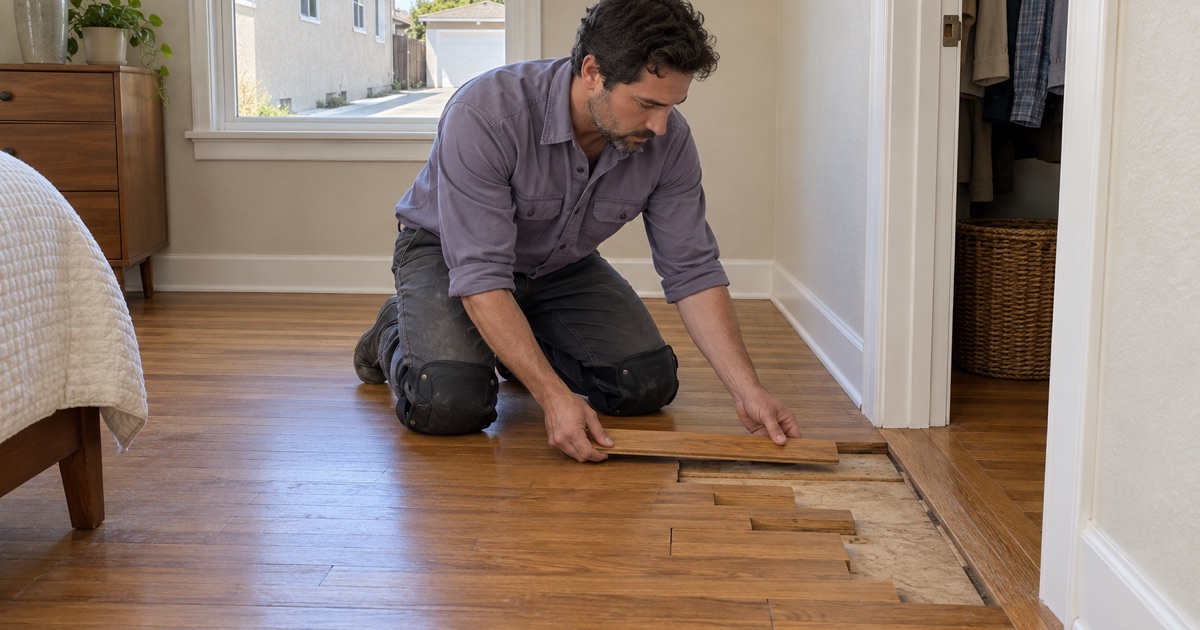
When boards are broken, stained or rotted, we cut them out carefully without damaging the surrounding tongues and grooves. New boards are woven in, staggered with the existing joints so there is no straight seam across the floor, and then sanded and finished to blend.
Matching matters most on older floors. We match the species, width, grade and sawing of the original boards, and on 1950s oak we look for reclaimed or closely matched stock so the repair takes stain the same way as the wood around it.
Pet Urine and Water Stains
Pet urine that sits on a floor soaks through the finish and reacts with the wood, leaving dark gray or black stains. Light staining that stays in the finish can often be sanded out, but deep staining generally means replacing the affected boards.
Water marks behave the same way. A white haze usually sits in the finish and can be removed, while a black mark means water reached the wood. We sand a test area before quoting so you know which case you are in.
Termite Damage in Boards and Joists
Drywood termites leave frass, small pellets that pile up below infested wood, and can hollow boards from the inside. Subterranean termites can weaken joists and the subfloor from below. Once treatment or fumigation is complete, we remove damaged boards and inspect what lies beneath.
Where a joist needs sistering or a subfloor section needs replacing as part of a flooring-scale repair, we handle it before relaying boards. Structural damage beyond that is referred to the right trade before any new flooring goes down.
Repairs on Older Lakewood Floors
Patching Where a Wall or Floor Furnace Was Removed
Opening up a wall, removing an old floor furnace or adding a room leaves a gap in the flooring. We lace new boards into the existing floor rather than filling the gap with a strip, so the repair follows the pattern of the room.
Once the new boards are in, we usually recommend refinishing the connected area so the new wood and old wood take the same stain and sheen. That is what keeps a repair from reading as a patch in the middle of the room.
Finish Problems: Peeling, Slippery and Worn Through
Peeling polyurethane and a slippery floor finish often come from a recoat applied over cleaning product residue. Worn-through traffic lanes show age. We test the existing finish and decide whether a screen and recoat will bond or whether the floor needs full sanding before any new coat.
Lead-Safe Repairs in Pre-1978 Homes
Cutting out boards and sanding a repair area in a house built before 1978 can disturb lead paint on nearby baseboards and trim. We follow EPA Renovation, Repair and Painting rule work practices, contain the work area and clean up carefully so lead dust does not spread through the house.
Floor Repairs for Claims, Sales and Rentals
Documented Repairs for an Insurance Claim
When a leak or accident damages a floor, the insurer needs to see the cause, the extent and the scope of repair. We photograph the damage, record moisture readings, and write a line-by-line estimate, the format the California Department of Insurance claims guide tells homeowners to ask for.
That level of detail helps when an adjuster’s scope and a contractor’s scope differ. Each board replaced, each area sanded and each coat of finish is its own line, so any disagreement is about a specific item rather than a single total.
Repairs Before Listing a House
Buyers notice squeaks, stained boards and worn finish on the first walkthrough, and an inspector will often note them in a report. Repairing those items before listing, and then refinishing where needed, usually costs far less than replacing the floor and removes a line from the buyer’s list of objections.
We schedule repair and refinishing around your listing date, leaving enough time for the finish to cure before staging and photography. If an inspection report has already flagged the floor, we work from its notes so each item is addressed.
Repairs Between Tenants
For a rental turnover, landlords need to separate normal wear from damage caused by a tenant, which matters when a security deposit decision under Civil Code 1950.5 follows. We document the floor’s condition, repair what is needed, and describe the work in writing so the record is clear.
A floor that has lifted, rotted or become a trip hazard can also raise habitability questions for a rental. We prioritize repairs that affect safety, then quote cosmetic work separately so you can plan it around the next lease.
Using Lakewood’s Home Improvement Loan
The City of Lakewood’s rehabilitation loan program for eligible owner-occupants lists flooring repair or replacement among the improvements it covers, as well as repair of termite damage. We provide the detailed written estimate the application process asks for, and the city decides eligibility.
- 20+ Years in Wood Flooring
- Line-by-Line Written Estimates
- Lead-Safe Sanding on Pre-1978 Homes