
Lakewood Wood Flooring builds, replaces and refinishes hardwood stairs in Lakewood, CA, with more than 20 years in wood flooring, serving surrounding cities including Artesia, Bellflower, Hawaiian Gardens, Cerritos and Signal Hill. We install new treads and risers, convert carpeted stairs to hardwood, refinish worn wood stairs and fit stair nosing so the stairs meet your floors cleanly.
Stairs take more wear than any other part of the floor. Every trip up and down lands on the same small area of each tread, and the front edge, the nosing, takes the most abuse. Loose treads and worn nosing are not only cosmetic problems; they affect how safely people move through the house.
We price stairs per tread and riser rather than folding them into a square-foot flooring number. Each step takes its own measuring, cutting and fitting, and listing it separately on the estimate shows you exactly what the stair work costs.
Treads, Risers and Nosing
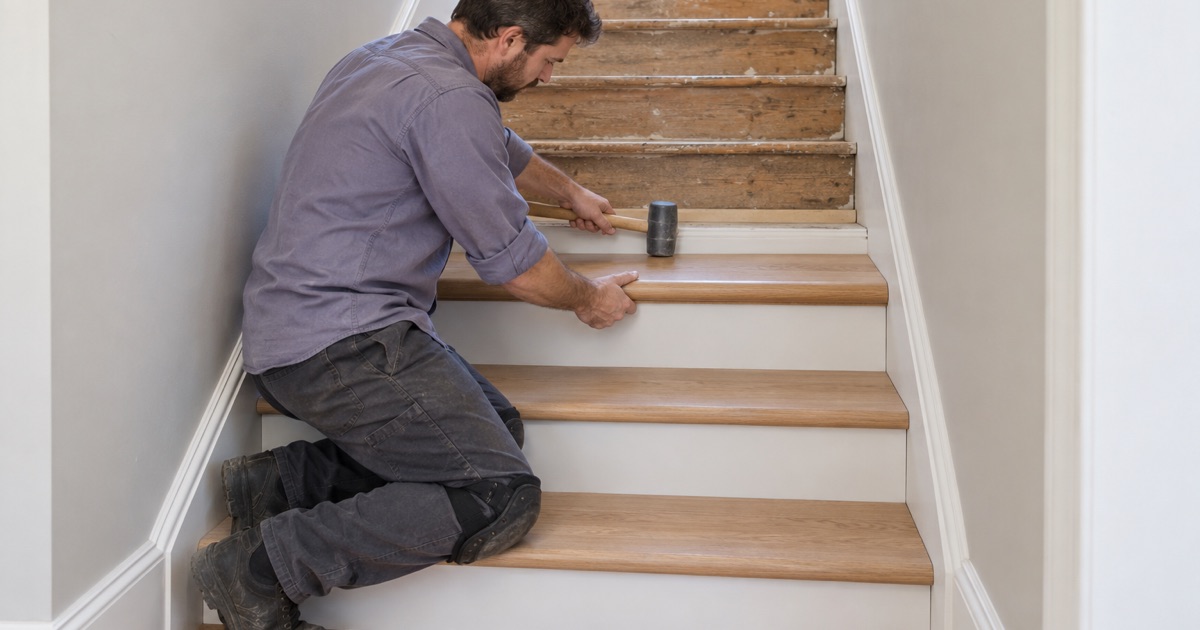
Stair Treads
The stair tread is the horizontal board you step on. Hardwood treads are usually solid wood, often red oak or white oak, and they need to be thick enough to span the stringers without flexing.
We measure each tread individually, because older stairs are rarely perfectly uniform. Every tread is cut and fitted to its own opening, then glued and fastened to the stringers so it stays tight and quiet.
Stair Risers
The riser is the vertical board between treads. Risers can be finished in the same wood as the treads, painted white for contrast, or finished in a complementary color.
Painted risers with stained treads are a popular choice because they brighten the stairway and hide scuffs from shoes. We finish risers before or after installation depending on the look and the paint system.
Stair Nosing
Stair nosing is the rounded front edge of each tread and the matching piece where a floor meets the top step. It protects the edge, softens the step and gives the stair a finished look.
Where new hardwood flooring meets a stair, we fit a flush stair nosing that matches the floor’s species and thickness. That avoids the awkward lip that appears when a floor is simply butted against an old tread.
Converting Carpeted Stairs to Hardwood
What Is Under the Carpet
When carpet comes off a stair, what lies underneath varies. Some stairs have finished hardwood treads that were carpeted later, some have rough construction-grade treads never meant to show, and some have treads cut flush with no nosing at all.
We inspect the stair after carpet removal and explain which approach fits: refinishing existing hardwood, capping the old treads with new hardwood, or removing them and installing full new treads.
Capping Existing Treads
Capping installs a new hardwood tread over the existing one, often after cutting back the old nosing. It avoids tearing out the stair structure and works well where the original treads are solid and level.
We check the rise of each step after capping, because adding thickness to the treads changes the height of the top and bottom steps. Keeping those rises consistent is important for safe walking.
Replacing Treads Completely
Where old treads are rough, split or not strong enough, we remove them and install full hardwood treads and risers. This gives the cleanest result and lets us correct uneven steps and loose stringers while the stair is open.
Choosing a Species for Stair Treads
Stair treads need a species hard enough to take concentrated wear at the nosing. Red oak and white oak are the usual choices because they are durable, widely available as stair parts and take stain in the same way as oak floors. Hickory is harder still, while maple is hard but can stain unevenly.
The Janka hardness rating gives a useful comparison between species, but finish and sheen matter as much on stairs. A durable finish in a satin sheen protects the treads and keeps shoe marks from standing out.
Refinishing Wood Stairs
Sanding Treads and Risers
Stairs cannot be sanded with a drum sander, so we sand them by hand and with small orbital sanders and detail tools. It takes longer per square foot than a floor, which is another reason we price stairs by the step.
On a house built before 1978, stair risers and stringers often carry old paint that may contain lead. We follow EPA Renovation, Repair and Painting rule work practices and contain the work area when sanding near painted surfaces.
Stain and Finish on Stairs
Stairs are stained to match the floors they connect, and we test the stain on a tread before doing the whole stair. We usually recommend a satin or matte sheen on treads, which hides wear and feels less slippery than gloss.
The finishes we apply meet the 275 g/L VOC limit in SCAQMD Rule 1113, and we plan the order of coats so the household can still use the stairs, often finishing every other step first.
Safety, Repairs and Coordination
Loose and Squeaky Treads
A tread that squeaks or moves is usually loose on its stringer or has lost its glue bond. We refasten loose treads from above or below, add adhesive, and replace any tread that has split or worn thin.
Where several treads move together, the problem can be in the stringers or the framing under the stair rather than the treads themselves. We check that before replacing treads, so new wood is not fastened to a base that is still moving.
Handrails and Code Questions
Stair geometry and handrails are covered by the building code, and Lakewood’s own residential design standards call for at least one handrail on stairs. Our work is the treads, risers and nosing; where a project touches railings or stair structure, we coordinate with the right trade so the stair meets the rules that apply.
Stairs as Part of a Larger Floor Project
Stairs often go with a new floor or a refinish in the rooms above and below. Doing them at the same time means one stain match, one finish schedule and one visit, and we list the stair work separately so you can see its share of the cost.
- 20+ Years in Wood Flooring
- Line-by-Line Written Estimates
- Lead-Safe Sanding on Pre-1978 Homes