
Lakewood Wood Flooring provides hardwood floor installation in Lakewood, CA, backed by more than 20 years of wood flooring work, and serving surrounding cities including Artesia, Bellflower, Hawaiian Gardens, Cerritos and Signal Hill. We install solid and engineered hardwood in new rooms, additions and remodels, and we lay new boards into existing floors so the join does not read as a patch.
A new hardwood floor is only as good as what it sits on. Before we order any material, we measure the moisture in the subfloor or slab, check the framing for bounce and sag, and confirm the floor is flat enough for the product you choose. Those readings go in writing, alongside a line-by-line estimate that separates removal, preparation, material and installation.
We also check what is already under the floor. Many Lakewood houses were built in the early 1950s with hardwood floors, and original oak sometimes sits beneath carpet or linoleum. When it is there and in good shape, refinishing it can make more sense than installing something new, and we will tell you so.
Choosing Hardwood for Your Home
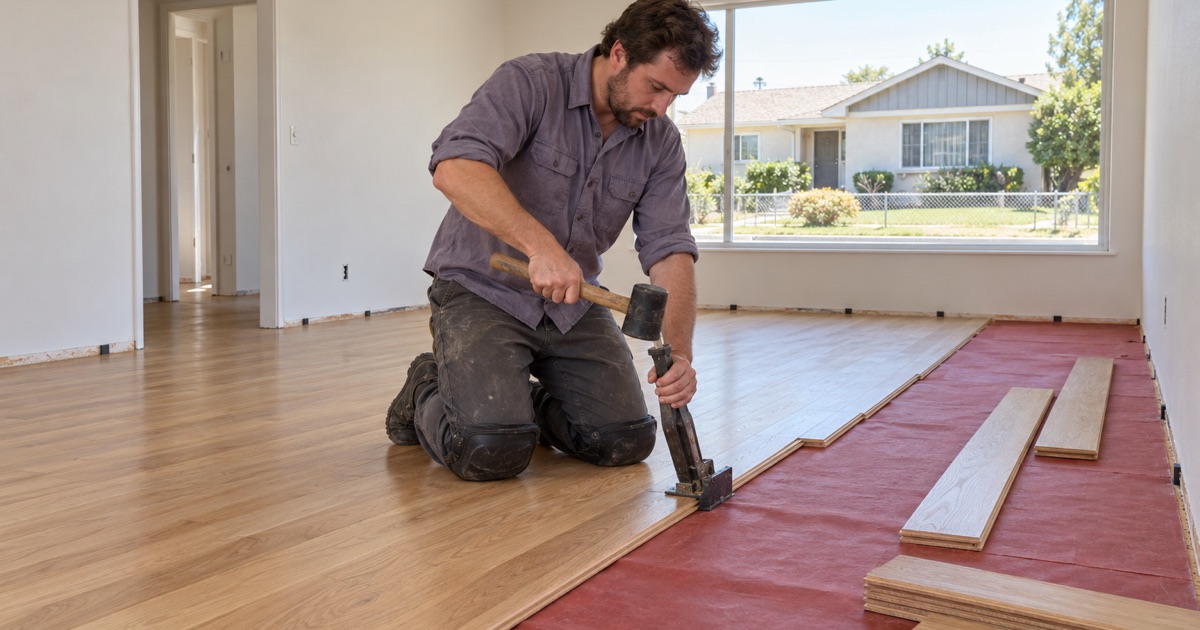
Solid Hardwood Flooring
Solid hardwood is milled from a single piece of wood, usually three-quarters of an inch thick. It can be sanded and refinished many times over its life, which is why original solid oak floors in Lakewood homes are still in service after seven decades.
Solid wood suits a raised foundation with a sound board subfloor or plywood underlayment. It is more sensitive to moisture than engineered flooring, so it needs careful acclimation and stable indoor conditions to avoid gapping and cupping over the seasons.
Engineered Hardwood Flooring
Engineered hardwood has a real wood wear layer bonded to a layered core. That construction resists the seasonal movement that makes solid wood cup or gap, which makes engineered flooring the usual choice over a concrete slab or in rooms near water.
The wear layer thickness decides how many times the floor can be refinished in the future. We show you that figure for each product we recommend, along with the core construction and the approved installation methods.
Species and the Janka Hardness Rating
White oak and red oak remain the most common choices, taking stain well and sitting in the middle of the Janka hardness scale. Hickory is harder and more varied in color, while maple is hard but can take stain unevenly.
We bring samples so you can see each species under your own light and against your cabinets and trim. For homes with pets or heavy traffic, we pair a harder species with a textured surface and a lower sheen.
Preparing the Subfloor and Slab
Moisture Testing Before Installation
Moisture is the main reason new wood floors fail. Over a raised foundation we measure the subfloor with a wood moisture meter; over a slab-on-grade we run a calcium chloride moisture test or an ASTM F2170 in-situ relative humidity test. The readings are written down before any material is ordered.
We then compare those readings with the moisture content of the delivered flooring. Acclimation is complete when the wood and subfloor sit within the range the manufacturer and the NWFA installation guidelines allow, not after an arbitrary number of days.
Subfloor and Joist Repairs
A soft spot, bounce or sag in the old floor is a warning about the base the new floor will sit on. We trace those areas to the subfloor and the joists, replace damaged board subfloor or plywood underlayment, and sister joists where the repair is within a flooring job.
When a problem is structural beyond that scope, we refer it out and tell you before any flooring goes down. Installing new hardwood over a failing subfloor only hides the problem until it shows up again as squeaks and movement.
Removing Old Flooring Safely
Old carpet and tack strip come up easily, but older linoleum, rubber floor tile, 9x9 tile and black mastic can contain asbestos. We treat those materials as a question for an asbestos survey before removal and follow SCAQMD Rule 1403 requirements when asbestos is present.
In houses built before 1978, removal and sanding near painted trim can disturb lead paint. We follow EPA Renovation, Repair and Painting rule work practices to contain lead dust during the work.
Installation Methods and Layouts
Nail-Down Installation
Solid hardwood over a wood subfloor is usually installed nail-down, using cleat nails or flooring staples driven through the tongue at the spacing the manufacturer specifies. Fastening into the joists where possible reduces squeaks and keeps the floor tight.
Glue-Down and Floating Installation
Over a concrete slab, engineered flooring is usually glued down with an adhesive that suits the slab’s moisture readings, or floated over an underlayment with a vapor retarder. Floating floors install quickly but can sound hollower underfoot, and glue-down floors feel more solid.
Wide Plank, Herringbone and Chevron
Wide plank flooring shows more of each board’s grain and color, and it needs careful moisture control because wider boards move more. Herringbone and chevron patterns take more layout, cutting and labor, and they are planned from a center line so the pattern reads square to the room.
For any layout, we plan board direction, transitions and the expansion gap at every wall before the first row goes down. Those choices affect how the floor looks from the front door and how it performs across seasons.
Installing Hardwood in Lakewood Homes
Matching New Boards to an Existing Floor
When a wall comes out between a hardwood living room and a carpeted bedroom, or a room is added at the back of the house, the new flooring has to meet the old. We match the species, width and grade of the existing boards and weave the new ones into the old floor rather than stopping them at a straight line.
On a 1950s oak floor, finding a match can mean reclaimed boards or stock milled to the same width. After installation, we usually sand and refinish the connected rooms together so the old and new wood take the same stain and sheen.
Hardwood in Kitchens and Near Water
Running hardwood through the kitchen creates a continuous floor, but the kitchen is also where leaks happen. We plan around the dishwasher, sink and refrigerator lines, recommend engineered flooring where moisture risk is higher, and keep spare boards from the same lot for future repairs.
Condos, Townhomes and HOA Approval
Many associations restrict hard flooring because of noise between units, and Civil Code 4760 covers owner alterations in common interest developments. Before installing in a condo or townhome, we read the association rules, confirm the required sound underlayment and help you gather the product sheets the board asks for.
Replacing Carpet With Hardwood
Carpet removal often uncovers a subfloor that has never been seen since the house was built. We check it for level, soft spots and old damage, correct what is needed, and plan transitions to neighboring rooms so the new hardwood sits at the right height.
Finishing the Installation
Prefinished Versus Site-Finished Floors
Prefinished boards come with a factory finish and are ready to use as soon as installation ends. Site-finished floors are sanded flat after installation and finished in place, giving a smooth surface and any stain color you choose.
Site finishes we apply meet the 275 g/L wood-coating VOC limit in SCAQMD Rule 1113, which covers Lakewood as part of the South Coast air basin. That rules out some older solvent-heavy products, and it also means less odor in the house while the finish cures.
Trim, Transitions and Stairs
We finish the edges with shoe molding or baseboard, install reducer strips and T-molding where floor heights change, and fit stair nosing where the new floor meets a stair. Stairs are priced per tread and riser, not folded into the square-foot price.
Scheduling and Cure Time
Work runs inside the city’s permitted construction hours, and for site-finished floors we give you a written cure schedule showing when each room can take foot traffic, furniture and rugs.
- 20+ Years in Wood Flooring
- Line-by-Line Written Estimates
- Lead-Safe Sanding on Pre-1978 Homes